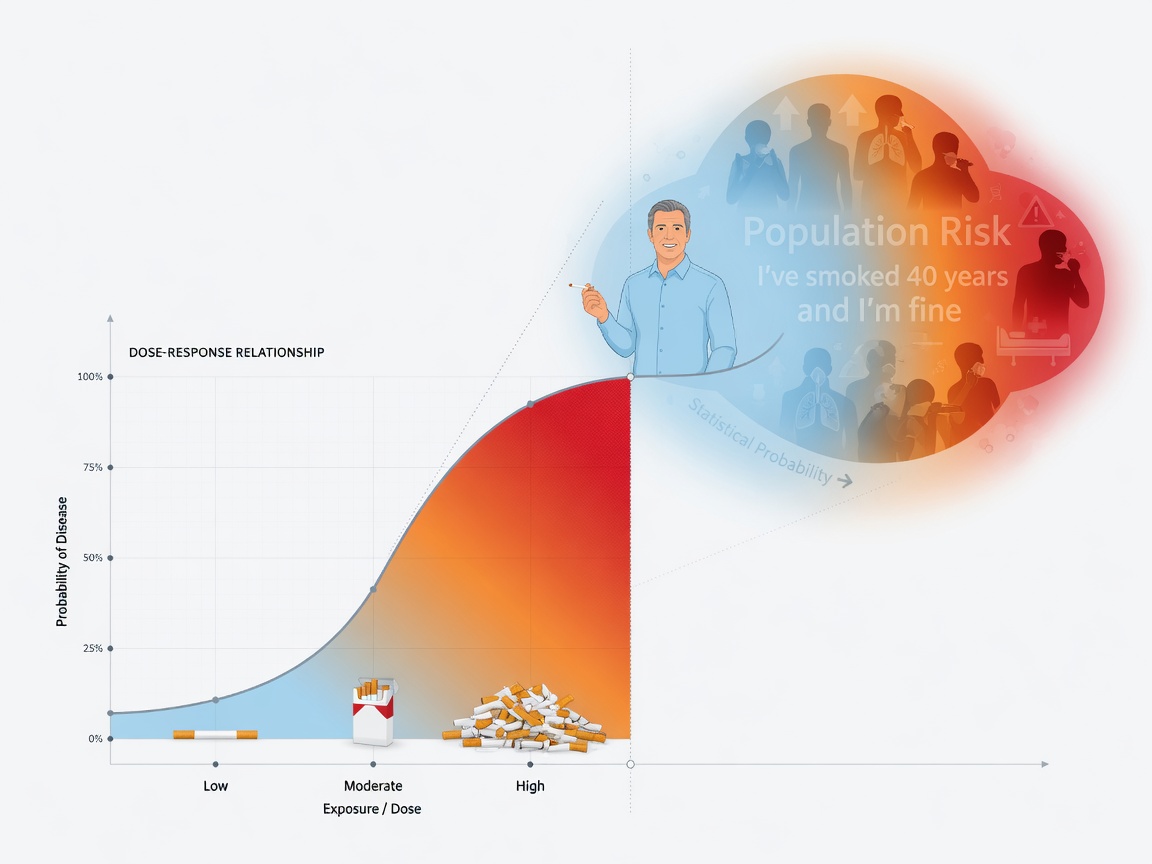
"I've smoked for decades and I'm fine" is the most common saying at the dinner table. This article uses the dose-response relationship to explain why personal experience cannot overturn population evidence, and how individual differences and latency create the illusion of "I'm fine."
Why "I've Smoked for Decades and I'm Fine" Is Not a Valid Argument? Dose-Response Relationship Explained
The most common "reassurance" heard at the dinner table is probably:
"I've been smoking for decades and I'm fine, right? My dad smoked his whole life, he's over eighty and still going strong."
The person saying this is usually not deliberately arguing. They have genuinely seen people around them who have smoked long-term without any dramatic catastrophic outcome so far; they themselves may have medical checkup reports that temporarily show "no major problems," or at least "still able to work and socialize."
Personal experience is real.
But real experience does not automatically equal **valid scientific evidence** — especially when it is used to negate the conclusion that "smoking increases the risk of multiple diseases, and the risk tends to rise with cumulative exposure," a conclusion repeatedly supported by long-term epidemiological studies.
This article explains four things as clearly as possible:
- Why "I've smoked for decades and I'm fine" **cannot** overturn population-level evidence;
- How the **dose-response relationship** explains "some are worse off, some seem okay for now";
- How **individual differences** and **latency period** create the illusion of "I'm fine";
- Why **early harm reduction/cessation** still makes sense even if you currently feel fine.
**Disclaimer:** This article is for health science communication and scientific thinking explanation. It does not constitute individual diagnosis, prognosis judgment, or prescription advice. If you experience chest pain, hemoptysis, progressive dyspnea, persistent hoarseness, unexplained weight loss, or other warning signs, seek medical attention promptly. For specific cessation plans (medication, nicotine replacement, comorbidity management), consult a licensed physician or an accredited smoking cessation clinic.
I. Putting the Conclusion on the Table First: Two Things That Can Both Be True
Before diving into terminology, allow a statement that sounds "contradictory" but is actually not contradictory at all:
| Statement | Can it be true? |
|-----------|-----------------|
| There indeed exist long-term smokers who have not been diagnosed with lung cancer for years and whose daily function is acceptable | ✅ Yes |
| At the population level, smoking increases the risk of various cancers, cardiovascular diseases, COPD, etc., often showing a trend of higher risk with greater exposure | ✅ Yes |
| Therefore "I'm fine" proves "smoking is not dangerous overall" | ❌ No |
The key point: **Medical risk talks about probability and degree, not an on-off switch.**
Smoking does not press the same "get sick immediately" button for every person. Instead, it **pushes up** the chance of many diseases, **pushes forward** the age of onset, and **pushes heavier** the burden once disease occurs. How much it pushes varies by individual; but "someone hasn't been pushed off the cliff" does not prove "the pushing force doesn't exist."
It's like:
- Someone has a high alcohol tolerance and temporarily normal liver enzymes — that doesn't prove alcohol is harmless;
- Someone stays up late for years and can still go to work — that doesn't prove sleep debt doesn't exist;
- Someone runs red lights countless times without an accident — that doesn't prove running red lights is safe.
Anecdotes are stories; evidence is distribution.
II. Dose-Response Relationship: Risk Is Often Not "Yes or No," but "How Much and How Long"
1. A Life-Oriented Definition
**Dose-response relationship** describes: when other conditions are comparable, there tends to be a trending association between **the dose of exposure (intensity × frequency × duration, sometimes plus absorption efficiency) and the probability or severity of adverse outcomes**.
It does not require that "every additional cigarette increases everyone's risk of a certain disease by exactly 0.1%." Instead, it points to a very common pattern:
**The more the exposure, the more likely, the more severe, or the earlier the bad outcome, on average.**
Everyday analogies:
| Exposure | Rough "Dose" | Common Reaction Trend (Illustrative) |
|----------|--------------|--------------------------------------|
| UV radiation | Duration, intensity, protection | Sunburn → sun damage → increased risk of long-term skin damage |
| Noise | Decibels × time | Temporary tinnitus → hearing fatigue → increased risk of hearing damage |
| Salt | Long-term intake level | Associated with blood pressure burden, etc. (individual sensitivity varies) |
| Tobacco smoke | Cigarettes per day × years, inhalation depth, starting age, etc. | Overall trend of multi-system disease risk increasing with cumulative exposure |
You don't need to be a toxicologist to grasp this sentence:
"Being fine" is often just one position on the dose-response curve, not proof that the curve doesn't exist.
2. "Dose" in the Tobacco Context Goes Far Beyond "Smoke or Not"
When people talk about "smoking" in everyday conversation, scientific discussion of exposure typically considers at least:
- **Intensity**: How many per day, whether smoking the whole cigarette, whether inhaling deeply;
- **Duration**: How many years of smoking history, starting age;
- **Cumulative intuition**: Indicators like "pack-years" (roughly packs per day × years) help compare "total magnitude" — they are not a personal destiny formula, but a useful communication tool;
- **Absorption and usage**: Burning smoke, deep inhalation, concurrent use of multiple tobacco products, etc.;
- **Additional exposure**: Secondhand smoke, occupational dust, air pollution, previous respiratory diseases, etc.
Therefore, when two people both say "I smoke," the actual dose may differ by an order of magnitude.
What does "I've smoked for decades and I'm fine" actually mean by "smoked"?
- A few social cigarettes per day, or more than a pack per day?
- Accompanied by heavy drinking, staying up late, lack of exercise?
- Never getting checkups, equating "not diagnosed" with "no disease"?
- Already having cough, periodontal issues, rhinitis-like symptoms, declining exercise tolerance — just normalized?
If the dose is not specified, "being fine" can hardly serve as testable evidence.
3. "Being Fine" Often Measures the Wrong Endpoint
Many people define "being fine" as:
- Not having lung cancer; or
- Not being hospitalized; or
- Still able to work.
But the list of tobacco-related damage is far broader than a "lung cancer switch":
- Cardiovascular event risk (often closer to the real risk of middle-aged smokers than "fear of cancer");
- Lung function trajectory toward chronic bronchitis and COPD;
- Oral health: periodontal disease, mucosal lesions, breath and healing capacity;
- Nasal and upper airway chronic irritation;
- Reproductive health, wound healing, postoperative complication risk;
- Interaction with other disease management (e.g., diabetes).
From a dose-response perspective: **Even if one endpoint (e.g., diagnosed lung cancer) has not yet appeared, subclinical damage in other systems may already be accumulating.**
"Not having the thing I fear most happen" does not equal "zero effect of the dose."
4. Compensation Masks Early Signals
The human body has powerful compensatory abilities:
- Lung function has reserve capacity;
- Vascular disease can remain "silent" for a long time;
- Repeated mucosal damage and repair may only manifest early as "persistent minor complaints."
Thus, a typical illusion arises in daily life:
"I've been like this for years — it means my body can handle it."
A more accurate translation is often:
"So far, the damage hasn't exceeded the threshold of what I can perceive or what has been detected by examination."
The dose-response relationship cares about trends and accumulation, not how you feel today.
III. Individual Differences: Explaining "Scatter," Not Proving "Safety"
1. Why Do Some People "Seem to Withstand It"?
Under similar exposure, different outcomes are almost the norm in biomedicine. Possible factors include (incomplete list):
| Category | Examples |
|----------|---------|
| Genetics & Repair | Differences in DNA repair, detoxification enzyme pathways, inflammatory response tendencies, etc. |
| Baseline Health | Blood pressure, blood lipids, blood glucose, weight, existing chronic diseases |
| Behavior & Environment | Exercise, diet, sleep, occupational exposure, healthcare accessibility |
| Usage Pattern | Starting age, inhalation method, concurrent alcohol use |
| Competing Risks | Some may leave the observation window earlier for other reasons |
Individual differences tell us:
Population risk is a "cloud band" or distribution, not everyone pinned to the same point.
2. The Most Important Logical Correction
Many people draw the wrong conclusion from individual differences:
"Since some people smoke their whole lives and are fine, the danger must be exaggerated."
The correct interpretation is:
"Since there are people who are susceptible and people who are relatively less so, **you don't know in advance which end of the distribution you're on**; and population evidence shows that the center of the distribution has been shifted rightward (increased risk) by smoking overall."
Another analogy:
- Someone has worked at heights for years without incident — that doesn't prove not wearing a safety harness is reasonable;
- Safety regulations target **preventable population-level harm**, not guaranteeing immediate punishment for every individual violation.
Individual differences are a reason for humility (and therefore paying more attention to modifiable risks), not a license for wishful thinking.
3. "Non-smokers Get Sick Too" Proves Nothing
Another common retort:
"So-and-so never smoked and still got lung cancer/heart disease."
This sentence only shows that **disease is multifactorial.**
Correct reasoning in a multifactorial world is:
- Removing one important risk factor **cannot** guarantee zero risk;
- Keeping one important risk factor **often** raises the risk.
Epidemiology asks: "In comparable populations, how much do incidence/mortality rates differ between the exposed and unexposed groups?"
Not: "Does an exception exist?"
Exceptions almost always exist; science relies on systematic comparison, not collecting exceptions.
IV. Latency Period: Time Scales Fool Intuition
1. Many Damages Are "Chronic Accounts"
Several serious tobacco-related outcomes are often not settled the day after smoking a cigarette, but rather:
- Chronic stimulation and inflammation;
- Accumulation of DNA damage and rising probability of repair failure;
- Years of progression of atherosclerosis;
- Slow destruction of lung structure.
Public health communication often emphasizes that some diseases become apparent on a scale of **more than a decade or even longer** after exposure. Specific diseases and individual progress vary, but the directional consensus is:
"I'm okay" in the short term is inherently weak evidence against long-latency diseases.
2. Three Typical Sayings Fooled by Time
Saying A: "If something were going to happen, it would have happened already."
— Not necessarily. Many accounts only become obvious in the second half.
Saying B: "I actually found problems after quitting, so I might as well not quit."
— A more common explanation is: damage was planted during the smoking period; after quitting, checkups increase and symptoms receive more attention, so they are discovered. Quitting did not "create" the cancer. Risk decline after cessation also takes time, and different diseases decline at different rates.
Saying C: "Old people have smoked all their lives and are fine, so it must be safe."
— What you see are **people who have survived long enough to be seen by you** (see next section on survivor bias); and "being fine" may still overlook quality of life, medication burden, and cause-of-death composition.
3. How Latency and Dose-Response Work Together
Putting both together, the picture is:
- Daily dose "pours" cumulative exposure;
- Cumulative exposure slowly changes the risk trajectory on the time axis;
- Individual repair and luck influence when one breaks through the "clinically visible" surface;
- Therefore, at any arbitrary cross-section of life, you will see some people still below the surface — **they are not counter-evidence; they just haven't surfaced yet.**
V. Why Personal Experience Is Particularly Prone to Error as Evidence
Even if the story is compelling, personal experience as evidence for "smoking is not dangerous" has systematic weaknesses.
1. Survivor Bias (You See the People Still Sitting at the Table)
Dinner table sampling is highly non-random:
- People with severe COPD who rarely leave home are less likely to appear at noisy gatherings;
- People who have already died or become disabled from cardiovascular disease cannot personally say "I smoked my whole life";
- Those who can loudly declare "I'm fine" are themselves a **pre-screened sample**.
Thus, your social circle systematically **overestimates the proportion of long-term smokers who remain healthy.**
2. "Being Fine" Has a Vague Definition That Cannot Be Tested
Scientific evidence requires operational endpoints: incidence rate, mortality rate, lung function, event rate, etc.
Everyday "being fine" may include:
- Not having had a low-dose CT scan or not having lung function tested;
- Regarding chronic cough as a "standard smoker's trait";
- Attributing shortness of breath when climbing stairs to "getting older";
- Only comparing with "those worse off," not with "same-age non-smokers."
The vaguer the definition, the less reliable the conclusion.
3. Lack of Control: Key Questions Cannot Be Answered
The truly powerful question is:
If the same person had never smoked, what would their health trajectory have been?
Individual cases cannot answer this.
Population studies use controls, confounder adjustment, prospective follow-up, etc., to approach this counterfactual question as closely as possible. Personal stories naturally lack "the other self."
4. Confirmation Bias: The Brain Prefers Comfort
People tend to:
- Remember examples that support their habits;
- Forget or downplay counterexamples ("he had bad luck," "he worked too hard");
- Overestimate their own control and "resilient constitution."
This is not a moral defect; it is a cognitive default setting. The existence of scientific methods is precisely to counteract this default setting.
5. Hearing "Relative Risk" as "Personal Accusation"
When science communication says "smoking increases the risk of a certain disease," some people translate it as:
"So I'm definitely going to get it? I didn't get it, so you're lying."
A more accurate translation is:
"Across large populations, the smoking group on average experiences these outcomes more frequently and earlier; for a single individual, it changes probability, not a pre-written script."
**Probabilistic thinking** is the underlying language of modern medical communication; "personal accusation thinking" turns everything into quibbling.
VI. Seeing Clearly with a Table: "Personal Story" vs "Valid Evidence"
| Dimension | "I've smoked for decades and I'm fine" | More valid basis for health decisions |
|-----------|----------------------------------------|--------------------------------------|
| Sample | 1 person or a few acquaintances | Large-sample, reproducible population studies |
| Control | Usually none | Non-exposed/low-exposed control group |
| Time | Up to the present moment | Sufficient follow-up, considering latency |
| Endpoint | Casual "being fine" | Clear disease and functional indicators |
| Confounding | Hard to separate (alcohol, exercise, healthcare) | Addressed as much as possible through design and statistics |
| Generalizability | Poor | Better (still need to consider population extrapolation boundaries) |
| Decision implication | Comfort, maintain status quo | Assess modifiable risk, support cessation |
Reasonable uses of personal stories:
- Expressing experience (withdrawal discomfort, social pressure, taste changes);
- Providing support and empathy;
- Serving as an example of "I can try to change too."
Unreasonable uses of personal stories:
- **Using them alone to negate dose-response and population risk**;
- **Providing "scientific immunity" for one's own or family members' high-exposure behavior.**
VII. Common Arguing Tactics: Quick Response List
1. "My grandpa smoked until 90."
Congratulations on your family's possibly good genetic makeup; this neither cancels the average harm of smoking nor guarantees you will replicate the same outcome. Longevity is a multifactorial result, not a proof of tobacco efficacy.
2. "Non-smokers get lung cancer too."
True, so lung cancer is not exclusive to smokers. At the same time, smoking remains a very important preventable risk factor. Multifactorial does not mean the factor is ineffective.
3. "Doctors smoke too."
Professional identity does not equal immunity. The behavior of individual professionals cannot replace clinical guidelines and public health evidence.
4. "I smoke very little, it's fine."
The meaning of dose-response is precisely that less is usually better than more, but "less" does not equal "zero risk," especially with long-term regular exposure. Reduce if you can; stop if you can do better.
5. "It's all fate/genetics."
Genetics influences susceptibility; behavior changes your exposure given that susceptibility. The two are not mutually exclusive.
6. "Science changes its story every day now."
The core conclusions about tobacco harm (burning tobacco smoke is harmful, cessation is beneficial) are long-term stable, multi-country, multi-disciplinary convergent consensus, not a shifting topic on short-form videos. Detail research advances, but the main conclusion is not flipping back and forth.
7. "I've already smoked for decades, it's too late."
Latency and cumulative damage indicate that "the sooner the better"; dose-response also shows that "stopping the accumulation" still changes the future trajectory. Many cardiovascular risks improve relatively faster after cessation; some cancer risks decline more slowly — but the direction is generally that benefit outweighs continuing. For individual assessment, consult a doctor.
8. "You're trying to scare me into buying cessation products."
Healthy skepticism is fine. You can also take commercially neutral paths: clinic-based cessation, authoritative organization materials, behavioral substitution, exercise and sleep management. Separately evaluate the evidence hierarchy and whether someone is selling products.
VIII. If You "Really Feel Fine Right Now," What Does Dose-Response Suggest You Think?
1. Rewrite "Being Fine" as a More Honest Sentence
Try upgrading your habitual phrase to:
"So far, I haven't experienced the worst outcome I fear most; but I cannot infer from this that continued exposure is still worthwhile."
This sentence is longer, but closer to reality.
2. Focus on "Changeable Future Dose"
Past pack-years have already happened and cannot be zeroed out.
Every future cigarette is still an increment on the dose-response curve.
The smart part of decision-making is not pretending the past didn't happen, but rather:
- Stopping or reducing continued accumulation;
- Managing trigger scenarios and dependence (physical and psychological);
- Managing blood pressure, blood lipids, oral and nasal and respiratory symptoms;
- Getting screened when screening is due, rather than substituting with "self-assessment."
3. The Significance of Quitting Exactly Aligns with the Three Concepts in This Article
| Concept | What it means for quitting |
|---------|---------------------------|
| Dose-response | Stop adding more, change total future exposure |
| Individual differences | You don't know how susceptible you are, so even more reason to reduce avoidable risk |
| Latency | Acting now cuts losses for accounts not yet due |
If you are considering harm reduction paths (e.g., nicotine replacement, prescription medication assistance, behavioral intervention), please understand it as: **dealing with dependence and exposure in a controlled manner**, rather than seeking a philosophical victory that "proves smoking is harmless."
IX. Communication Advice for Advocates and Families (Less Taking Sides, More Framing)
When facing friends or relatives who insist "I've been fine for decades," blame is often ineffective. You can try:
- **Acknowledge the feeling first**: "You indeed haven't encountered the worst outcome yet, I hear that experience."
- **Then add the framework**: "Science compares the probability among groups of people; it doesn't deny your existence."
- **Use analogies**: "It's not saying you'll definitely have an accident tomorrow; it's saying the dice are loaded."
- **Land on one small actionable step**: Do a lung function or oral check first, delay the first cigarette, agree on a smoke-free car, etc.
- **Avoid shaming**: "You don't understand science" shuts ears; what opens them is respect plus a clear framework.
X. Summary: One Sentence to Remember the Entire Article
"I've smoked for decades and I'm fine" describes a slice of one individual's outcome at one point in time; the dose-response relationship, individual differences, and latency jointly indicate: a slice cannot overturn population patterns, luck cannot rewrite probability, today's subjective feeling cannot guarantee future cumulative exposure.
Valid evidence requires: clear exposure measurement, control, time and endpoint, and reproducible population-level evidence.
Personal stories are worth listening to, but when they are held up as "proof of tobacco safety," they go from experience to **logical overreach**.
If you are willing to do one thing for your future self that aligns with dose-response intuition, the simplest direction remains:
**If you can avoid adding more, don't add more; if you can stop earlier, it's more proactive than stopping later.**
Reference Directions (Reading and Verification, Not This Article's Fictional Precise Citation List)
If readers wish to verify and extend on their own, it is recommended to start with the following **types** of publicly available materials (please use the latest official versions):
- **World Health Organization (WHO)** fact pages and reports on tobacco epidemic, harm, and control;
- **National clinical cessation guidelines** (e.g., clinical practice guidelines including behavioral support and pharmacotherapy) for review of risks and interventions;
- **Introductory epidemiology and causal inference** readings/courses on association strength, dose-response, time sequence, bias and confounding;
- **Basic toxicology** textbook-level explanations of dose-response curves, thresholds, and individual sensitivity;
- **Public hospital cessation clinics or CDC** published science communication on cessation and disease risk for the public (distinguish science communication summaries from original research).
This article intentionally does not fabricate specific DOIs, precise percentage trial data, or pseudo-authoritative citations like "a certain year a certain journal a certain number settles it for life." The core argument relies on long-term stable disciplinary consensus structure: **exposure accumulates, risks tend to show trends, individual cases are not counter-evidence, cessation changes the future trajectory.**
*(End of article)*
Personal Experience
Sample size=1, no control, up to present, vague definition
Population Evidence
Large sample, with control, sufficient follow-up, clear endpoints
☞ Core of dose-response: the more exposure, the higher the average risk, but individual position cannot be predicted.